
Slate Floor Restoration Specialists
Slate at its Richest, Deepest and Most Beautiful.
Specialist deep cleaning and colour-enhancing impregnating sealers to bring out the natural depth slate is known for.
Riven, honed or flamed finishes — sealed properly, beautifully.
Free site visit, fixed-price quote.
Slate is one of the most visually rich floor surfaces you can have — fine-grained, layered, naturally multi-tonal, and at its best when properly cleaned and sealed. With the right colour-enhancing sealer, the deep greens, blues, rusts and blacks of the stone come fully to life. The transformation between a tired slate floor and a freshly restored one is often the most dramatic of any natural stone.
We restore slate floors across Surrey, Hampshire, Berkshire and South West London — riven, honed and flamed-textured finishes, in homes and commercial spaces. Most slate restorations are deep clean plus reseal rather than full mechanical refurbishment, because slate’s character is in its texture rather than a polished surface. The right sealer is what makes the floor read properly.
- Family-run, fully insured
- Free no-obligation site visits
- Fixed-price quotes, no hidden fees
- Usually respond within a few hours
We work on all common slate types found in UK properties — Welsh slate (the traditional UK choice, dense and dark), Brazilian slate (multi-coloured, popular in modern installations), Indian slate (varied tones from grey-green through rust), and Chinese slate (widely used in budget installations).
Each has slightly different density and colour characteristics, which affects how it cleans up and which sealer works best.
- Country kitchens
- Hallways & entrance halls
- Conservatories & orangeries
- Boot rooms & utility spaces
- Period & barn conversions
- Pubs, restaurants & receptions
"Firstly, thank you Philippe and team for translating my requirements into a stunning end result. For those looking for an outfit that can transform your hard flooring these are the guys! Great communication, hard work, punctual, going the extra mile, polite, and perfectionist's! All the qualities I admire, and competitive with their pricing."
Seb Gee, Google Reviews
Right sealer for the texture
Slate’s surface character matters. Riven and flamed-textured slate often looks best with a colour-enhancing or ‘wet-look’ sealer that deepens the natural colour and lets the texture read clearly. Honed or smooth slate can take a more discreet impregnating sealer.
Strip the old sealer first
Tired slate is almost always a sealer issue, not a stone issue. We use specialist strippers and rotary scrubbing equipment to remove failed acrylic sealers, old wax and ingrained dirt completely before re-sealing. Skipping the strip stage and re-coating over old product is the most common reason slate floors look patchy after “restoration”.
Colour enhancement that lasts
Colour-enhancing impregnating sealers don’t sit on top of the stone — they penetrate into the slate and bring out the natural colour from within. Done properly with the right product, the result is a deep, rich finish that stays consistent for years. We use products from established stone-care manufacturers with proven longevity.
Riven, honed or flamed
We work on every common slate finish — naturally riven (the cleft, textured surface most slate is sold with), honed (smoothed mechanically to a flat finish), and flamed-textured (heat-treated for grip and visual depth). Each takes a slightly different approach to cleaning and sealing; we adjust accordingly.
Grout cleaning included
Slate grout lines are typically dark and they trap dirt aggressively. Most slate floors look immediately better simply because the grout has been properly cleaned — and that’s almost always part of the job. We use stiff brushes and specialist grout cleaners to lift embedded dirt without damaging the slate.
Local, family-run, fully insured
Farnham-based family business, fully insured, with consistent 5-star customer reviews. Free site visit, written fixed-price quotation, no hourly creep, and no surprise add-ons. You’ll deal with the same team from start to finish.
See The Difference:
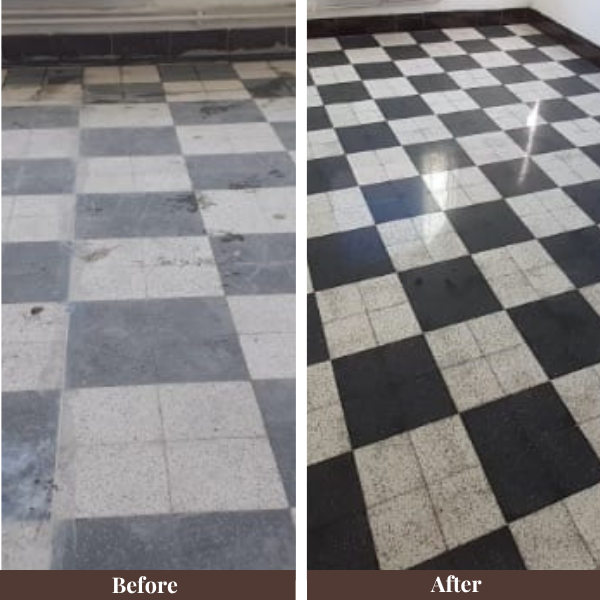
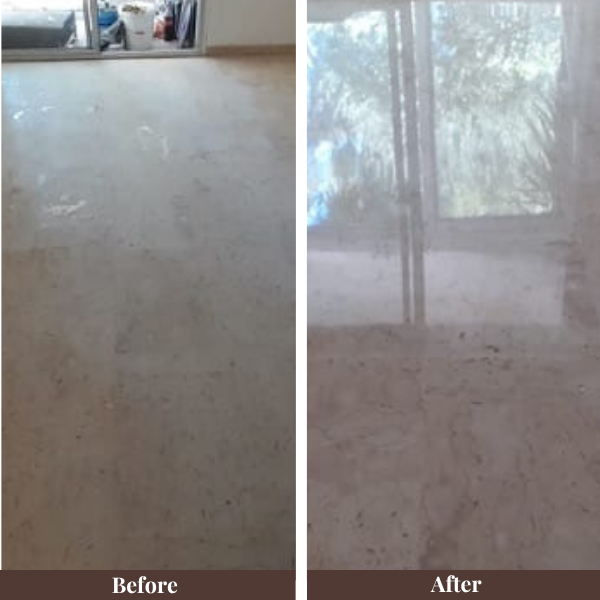
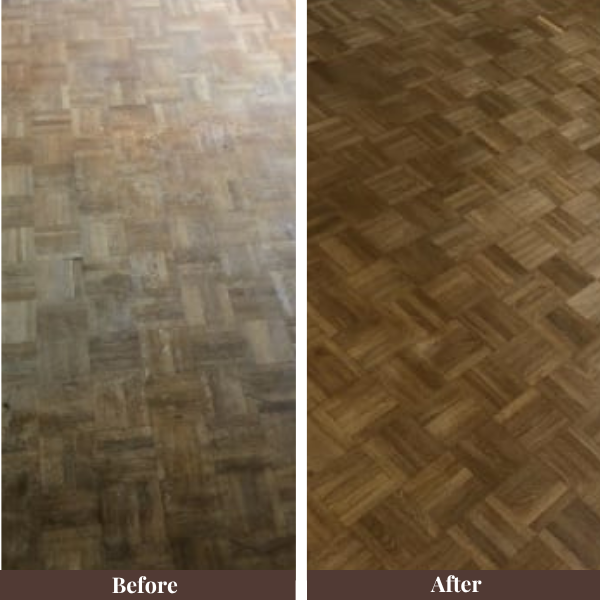
How We Restore Slate Floors
Most slate jobs centre on stripping the old sealer, deep cleaning, and applying the right new sealer — full mechanical refurbishment is rarer for slate because the texture itself is part of the appeal.
1) Site visit, finish discussion, fixed-price quote
We assess the slate type, the existing finish (if any), the condition of the grout, and any damaged tiles. We discuss whether you want a natural matte look, an enhanced look finish. You see sealer options and you get a written, fixed-price quote covering everything.
2) Strip old sealer and ingrained dirt
We apply specialist strippers and run a rotary scrubbing machine with appropriate pads to break down old acrylic sealers, wax, and trapped dirt. Slurry is removed by wet vacuum. The floor is then rinsed and neutralised. Grout lines are scrubbed separately with stiff brushes and grout-specific cleaners.
3) Deep clean and (where needed) light hone
Where slate has surface scratching or staining beyond what the strip stage handles, we lightly hone the surface with appropriate diamond pads. Most slate jobs don’t need this — but where it’s needed, it makes a significant difference. The texture of riven slate is preserved; only the dirt and damage come off.
4) Colour-enhancing impregnating seal and aftercare
We apply the chosen impregnating sealer — typically a colour-enhancing or natural-finish product depending on what suits the slate and the room. Multiple coats where needed, with absorption testing between each. You receive an aftercare guide covering pH-neutral cleaning, what to avoid, and a realistic resealing schedule (typically every 2–4 years for sealed slate).
Get a fixed price for your slate floor restoration
Free site visit, 7 days a week. We usually respond within a few hours.
What affects the price?
Slate restoration is quoted as a fixed price after a free site visit. Slate is generally less variable in price per square metre than marble or limestone because the work is more standardised — but the quote still depends on:
Existing sealer condition
Floors with thick, failed acrylic sealers take longer to strip than lightly-sealed or unsealed slate. The strip stage often takes more time than people expect.
Grout condition
Heavily soiled grout lines need separate scrubbing, sometimes with multiple cleaning passes. On slate floors with very dark or porous grout, this can be a significant element of the job.
Total area and access
Open conservatories and country kitchens are quicker per square metre than narrow hallways, awkward boot rooms, or rooms with built-in furniture to work around.
Sealer choice
Standard impregnating sealers are included as part of the service. For slate floors, we also offer colour-enhancing sealers, which help bring out the rich natural tones and character of the stone while maintaining a more natural appearance. If you would prefer a finish with more sheen or shine, we can also apply an alternative sealer to achieve that look.
Damaged or loose tiles
Slate can occasionally be cracked or have loose tiles that need re-bedding. We’ll identify these during the site visit and quote separately if significant. The site visit is free and there’s no obligation.
Frequently Asked Questions About Slate Floor Restoration
Why does my slate floor look dusty and washed out?
Almost always because the sealer has failed and is trapping dirt, or because the slate was never sealed properly in the first place. Stripping the old finish and re-sealing — usually with a colour-enhancing product — typically transforms how the floor reads. The slate underneath is generally fine; it’s the surface treatment that’s the issue.
What’s a ‘wet-look’ or colour-enhancing sealer?
An impregnating sealer with colour-enhancement properties. It penetrates into the stone and brings out the natural colour and depth of the slate — so the floor looks the way it does when it’s wet, but permanently. It doesn’t sit on top of the slate like a varnish; it works from within. Especially effective on riven and flamed slate where texture matters.
How often does slate need resealing?
Most domestic slate benefits from resealing every two to four years, depending on traffic and cleaning regime. Commercial slate needs it more often. The water-drop test is a good guide: if water beads on the surface, the sealer is still doing its job; if it soaks in quickly, it’s time. We’ll set realistic expectations in the aftercare guide.
Can damaged or loose slate tiles be repaired?
Often yes — cracked tiles can sometimes be filled or replaced individually if matching slate is available, and loose tiles can be re-bedded. We’ll assess specific tile damage during the site visit and tell you honestly what’s possible. Where matching slate isn’t available, we’ll be straight about the limits.
Will the work be messy or disruptive?
We work as cleanly as possible. Our machines use high-extraction vacuum systems to keep airborne dust to a minimum during dry stages, and wet-process stages are contained and cleaned up on site. We protect adjoining areas before we start, work to your schedule where we can, and tidy up before we leave. Most homes stay liveable around the work.
Which areas do you cover?
Surrey, Hampshire, Berkshire and South West London — including Guildford, Woking, Weybridge, Esher, Cobham, Farnham, Farnborough, Fleet, Basingstoke, Camberley, Ascot, Sunningdale, Windsor, Richmond, Kew, Barnes and Twickenham. For larger commercial sites we’ll travel further where the job is the right fit. Send us your postcode when you enquire and we’ll confirm.
How soon can you start?
We usually respond to new enquiries within a few hours and can often arrange a site visit within a couple of days, including weekends. Booking the work itself depends on diary — typically a week or two from quote acceptance, though we’ll always tell you honestly if it’ll be longer. Urgent commercial jobs we’ll prioritise where we can.

