
Wood, Tile & Stone Floor Specialists · Knaphill · Brookwood · GU21
Floor Restoration in Knaphill
Wood floor sanding, tile deep cleaning and natural stone restoration in Knaphill, Brookwood and the surrounding area. Free site visit, written fixed-price quote.
or call 07796 003 638
Knaphill’s housing grew in waves, and the floors reflect that. The 1930s semis along the main residential streets tend to have original softwood boards: pine, sometimes fir, often under carpet and often in good condition. The post-war and 1960s properties have a more variable picture. Some have original boards, some have concrete sub-floors, some have had engineered wood laid on top. The private estates built from the 1990s onwards have almost universally got engineered wood, and that’s where we get a lot of calls asking whether it can be sanded.
The answer to the engineered wood question is usually yes, but it depends on the wear layer, and that has to be checked at the site visit.
We also work on tile floors and natural stone throughout Knaphill, and occasionally on stone or parquet in the older properties near Brookwood. We come to your property, assess the floor in person, and give you a written price that covers everything agreed. No guesswork, no surprises.
- Family-run, fully insured
- Free no-obligation site visits
- Fixed-price quotes, no hidden fees
- Usually respond within a few hours
Floor restoration services in Knaphill
Wood floor sanding: original boards and engineered wood
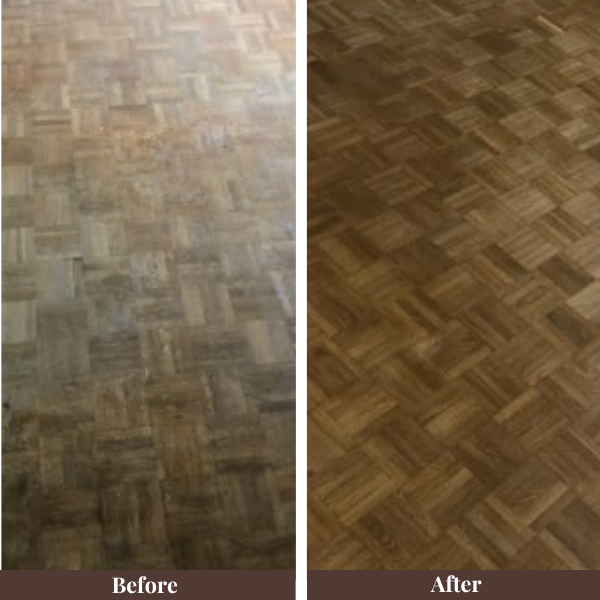
In Knaphill’s inter-war properties, original boards are typically softwood, pine or fir, in a 4–5 inch width that’s characteristic of 1930s builds. These are thick enough to sand multiple times and finish well with either lacquer for hardwearing areas or oil for rooms that see lighter use. Gaps between boards, common in older properties that have dried out over the decades, are filled with a colour-matched compound before finishing.
For Knaphill’s post-1990 housing with engineered wood, the key question at the site visit is wear layer thickness. Engineered boards fitted in this era typically have a 3–6mm hardwood top layer. If 2mm or more remains, a sand and refinish is straightforward. If the floor has been sanded before or the original layer was thin, we’ll tell you at the site visit and give you honest options.
Tile and grout deep cleaning
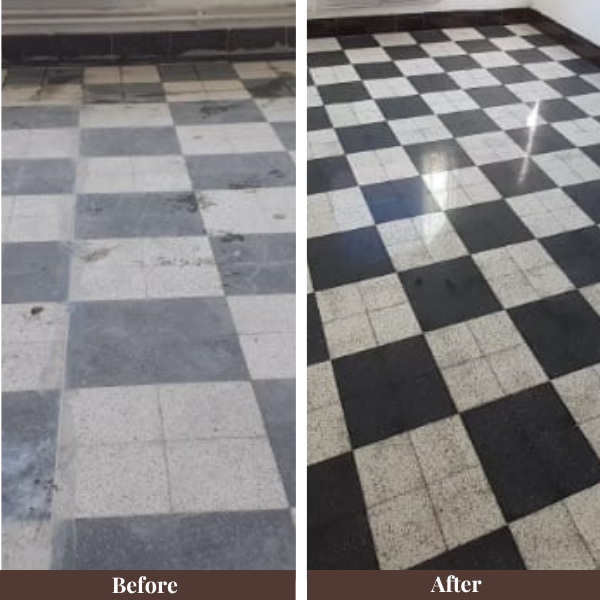
Tiled kitchen and hallway floors throughout Knaphill’s domestic stock, particularly in the 1980s and 1990s properties where ceramic floor tiles were the default choice, develop grout staining that builds up gradually and doesn’t respond to surface cleaning. The grout lines go from light grey or cream to dark brown or black, and the floor starts to look dirty permanently.
We use a rotary cleaning machine to work the cleaning solution into the grout properly, extract the residue with a wet vacuum, and then seal the grout and tile surface with an impregnating treatment. The seal slows re-soiling significantly, since sealed grout resists moisture and grease rather than absorbing them.
Natural stone restoration
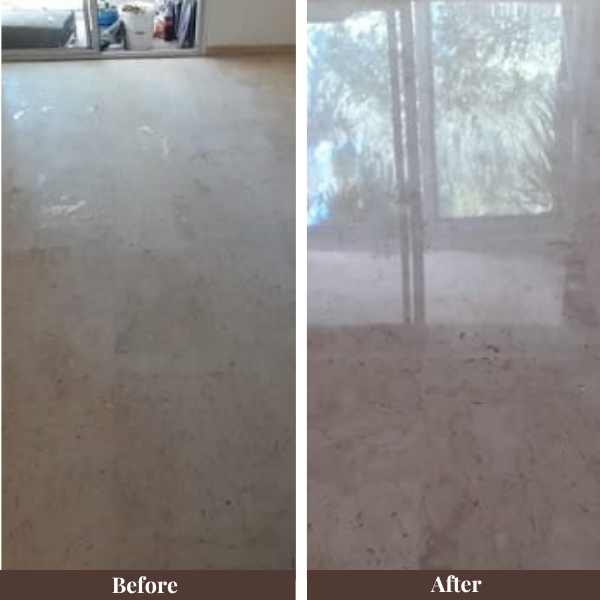
Knaphill’s newer private developments and recently renovated older properties often have limestone kitchen floors and travertine in bathrooms. Both are widely fitted but often sealed incorrectly at installation, using a surface coating rather than an impregnating sealer, which causes the coating to peel and the stone to look worse than if it hadn’t been sealed at all.
We strip the failed product, clean the stone thoroughly, and apply an appropriate impregnating sealer matched to the stone type and porosity. For stone that has also been scratched or etched, particularly limestone near kitchen areas, we can hone the surface back to an even finish before sealing.
We also carry out school hall floor restoration for schools around Knaphill and Brookwood, timed to fit holiday windows.
"Firstly, thank you Philippe and team for translating my requirements into a stunning end result. For those looking for an outfit that can transform your hard flooring these are the guys! Great communication, hard work, punctual, going the extra mile, polite, and perfectionist's! All the qualities I admire, and competitive with their pricing."
Seb Gee, Google Reviews
How floor restoration works in Knaphill
Call or email to start, and tell us roughly what you have or send a photo. We’ll usually come back to you the same day, then arrange a visit to your Knaphill home to check the floor type and condition, including wear layer testing for engineered wood, and discuss options. There’s no charge for any of this.
The price comes in writing. For engineered wood, we’ll include a note on the wear layer assessment so you know exactly what we found.
We arrive on the agreed day with equipment matched to the floor. Tile cleaning is contained and dust-free, and wood sanding uses high-extraction equipment that keeps most dust in the machine.
Written care guidance follows before we leave, specific to the floor type and the finish applied.
What does floor restoration cost in Knaphill?
The variables that affect a Knaphill quote most often relate to the town’s particular mix of floor types.
Engineered wood is sometimes quicker per square metre than solid if the floor is in good condition, though the assessment adds a step that solid-board jobs don’t need. Heavily soiled grout lines with embedded organic material take longer to clean than lightly stained ones, and we’ll give you a realistic timeline alongside the price. On stone, a limestone floor with a failed surface coating needs stripping before it can be properly assessed, which we factor into the quote upfront. Layout also plays a part: Knaphill’s post-war semis often have separate kitchen, dining and sitting rooms rather than open-plan areas, and tighter layouts take longer per square metre.
Written quote. Fixed price. No additions without discussion.
See the difference that professional floor restoration can make:
Get a written quote for your Knaphill floor
We cover Knaphill, Brookwood and the surrounding GU21 area. The site visit is free. If you’re not sure what floor type you have, that’s what the visit is for. We’ll check and tell you honestly what’s there and what it needs.
Questions we get from Knaphill homeowners
Our post-war semi in Knaphill has what looks like original boards, but some areas have concrete under the hall tiles. What’s going on?
This is very common in Knaphill post-war properties. Ground floors in many 1940s–1960s builds used a suspended timber floor in the main rooms but a concrete slab in the hallway, which was then tiled. So you can have original boards in the sitting room and concrete (with tiles on top) in the hall. Both are common and both are restorable: the boards can be sanded; the tiles can be deep-cleaned. We’ll map this out at the site visit.
The engineered oak in our Knaphill new-build looks dull and scratched. Is it too early to sand it?
There’s no minimum age, only a minimum wear layer. If the floor was fitted with a standard 4–6mm hardwood layer and hasn’t been sanded before, it’s almost certainly sandable, regardless of how old it is. We check the thickness at the site visit with a moisture meter and a close look at the joint profile. If the wear layer is sufficient, we quote for a full restoration. If not, we’ll tell you the options. Our guide to sanding engineered wood floors covers this in more detail.
We’ve had our kitchen tiles deep-cleaned before and they went grey again within six months. What’s different about what you do?
Almost certainly the previous clean didn’t include a proper grout seal. Unsealed grout is porous. It absorbs grease, moisture and particles from cleaning products, and it re-soils quickly. An impregnating sealer applied after a thorough deep clean changes the surface chemistry of the grout so that liquids bead rather than absorb. A properly sealed grout line typically stays clean three to five times longer than an unsealed one.
We have underfloor heating under our engineered wood. Does that rule out sanding?
No. Underfloor heating and engineered wood are a common combination in Knaphill’s newer properties, and it doesn’t prevent sanding. It does affect the choice of finish: some finishes perform better over UFH than others, and we’ll advise on the right option for your specific setup at the site visit. The main practical requirement is that the heating is turned down a few days before we start.
Do you cover the Brookwood area and the roads near Knaphill village?
Yes. We cover Knaphill village, Brookwood, and the surrounding GU21 roads including the areas towards Bisley and Pirbright. Travel within this area doesn’t affect the quote.
Transparent, Competitive Pricing

07796 003 638
