
Granite Floor Restoration Specialists
Granite With the Depth and Shine That Drew You to It.
Industrial diamond polishing calibrated for granite's exceptional hardness — deep colour, mirror reflectivity, and a finish built for the long term.
Free site visit, fixed-price quote.
Granite is one of the most durable and visually rich stones you can put on a floor — a hard, igneous stone with naturally occurring mineral depth and chemical resistance to most acids. Properly polished, it has a reflectivity and colour depth that softer stones can’t match. Bringing a tired granite floor back to that condition is a satisfying job, and almost always achievable.
We restore granite floors and feature surfaces across Surrey, Hampshire, Berkshire and South West London using calibrated diamond grinding and polishing systems sized for granite’s density. Most domestic granite needs only deep cleaning and refinement rather than full restoration; where damage is deeper, we run through up to nine grit stages to take the surface back to factory-fresh. Free site visit, fixed-price quote, no shortcuts on the grit sequence.
- Family-run, fully insured
- Free no-obligation site visits
- Fixed-price quotes, no hidden fees
- Usually respond within a few hours
We work on all common granite varieties used in UK homes and commercial spaces — Star Galaxy, Kashmir White, Black Pearl, Steel Grey, Ubatuba, Imperial White and others.
Granite's mineral composition (feldspar, quartz, mica) varies considerably between varieties, which affects how it polishes and how it accepts sealers.
We'll identify what you have during the site visit and adjust the process accordingly.
- Granite floors & hallways
- Granite worktops & islands
- Reception & commercial floors
- Granite stairs & thresholds
- Bathroom & wet-room granite
- Outdoor / entrance granite
"Firstly, thank you Philippe and team for translating my requirements into a stunning end result. For those looking for an outfit that can transform your hard flooring these are the guys! Great communication, hard work, punctual, going the extra mile, polite, and perfectionist's! All the qualities I admire, and competitive with their pricing."
Seb Gee, Google Reviews
Equipment calibrated for granite
Granite is two to three times harder than marble. Polishing it requires heavier rotary machines, often 100kg+, running diamond-encrusted pads in the right sequence. Softer stone equipment simply can’t generate the cutting action needed. We use machines and pad systems specifically rated for granite, which is why the finish lasts.
Up to nine grit stages
A full granite restoration can run through nine levels of diamond resurfacing, from coarse grits that level the surface through to fine pads and crystallisers that produce the final mirror finish. Each stage removes the scratch pattern from the one before. The depth of finish granite is famous for only emerges if every stage is properly executed.
Honest assessment first
Most granite enquiries don’t need full restoration. If your floor just looks tired, deep cleaning and re-sealing often does the job at a fraction of the cost. We’ll tell you honestly during the site visit which level of work the floor actually needs: clean and seal, polish only, or full grind-and-polish. Then we’ll quote accordingly.
Colour-matched chip repair
Granite’s hardness means impacts from dropped pans or moved furniture can chip the surface. We repair chips and cracks with colour-matched epoxy resins that are virtually invisible once polished. The repair sits flush with the surrounding stone, holds long-term, and doesn’t require tile replacement.
Sealing only where it helps
Many darker premium granites, including black, dark blue and dark green, are dense enough that they don’t need sealing at all. We test porosity during the site visit before recommending a sealer, so you don’t pay for a product the stone doesn’t need. Where sealing is right, we use premium impregnating sealers that don’t change the stone’s appearance.
Fixed price, family-run, fully insured
Free site visit. Written, fixed-price quote. That’s the price you pay. We’re a Farnham-based family business, fully insured, and reviewed on Google. You’ll deal with the same team from quote to final inspection, not a sales rep at the start and a different crew on the day.
See The Difference:
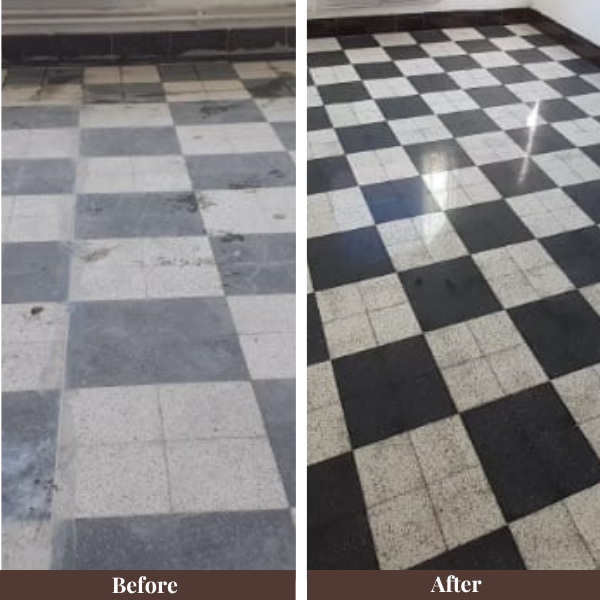
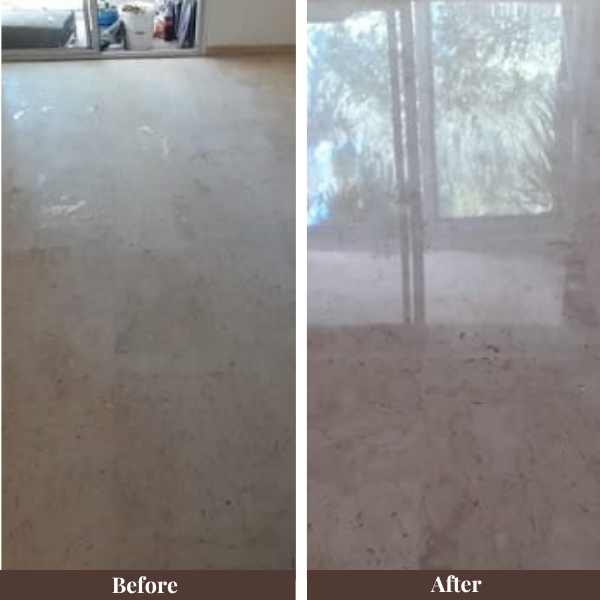
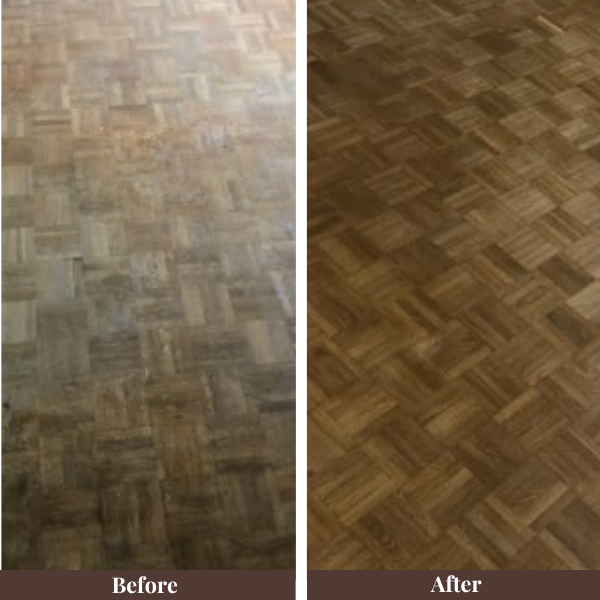
How We Restore Granite Floors
We start every granite job with an honest assessment. Many enquiries are for surfaces that need cleaning and refinement rather than full restoration. The process below covers the full restoration sequence, but lighter work simply skips the early stages.
Site visit, porosity test and fixed-price quote
We assess the granite type, condition and finish before recommending any work. This includes testing porosity to determine whether sealing is actually needed, as many darker granites do not require it. We also identify any chips, cracks or scratches that may need repair.
You then receive a written, fixed-price quote covering exactly the level of work your floor needs. No oversell, no vague allowances, and no surprises once the job starts.
Lippage removal and coarse grinding, where needed
If granite tiles are uneven, or there are deep scratches, we begin with coarse metal-bonded diamonds to flatten the surface. This is usually only needed where lippage is greater than around 1mm or the stone has more serious damage.
This stage can produce a dramatic visual change. Dark granites can look almost light immediately after grinding because the surface is full of fine scratches from the diamonds. That is normal. The later polishing stages remove those scratches and gradually bring back the depth, clarity and shine.
Honing and progressive polishing
We then move through diamond pads at progressively finer grits. Depending on the level of damage, this can involve six to nine stages, with each stage removing the scratch pattern left by the one before.
The final passes use ultra-fine pads, polishing powders and, where appropriate, crystallisers to achieve the deep mirror finish granite is known for. This is the stage where the stone’s colour, reflection and depth really return.
Repair, seal where needed, and aftercare
Chips and cracks are filled with colour-matched epoxy and re-polished flush with the surrounding stone, so the repair blends into the surface rather than sitting proud or looking obvious.
Where the porosity test shows sealing is beneficial, we apply a premium impregnating sealer that protects the stone without changing its appearance. We finish with a short aftercare guide covering the right pH-neutral cleaner, what to avoid, and a realistic resealing schedule. Residential granite typically needs resealing every three to five years, while commercial granite may need it annually.
Get a fixed price for your granite floor restoration
Free site visit, 7 days a week. We usually respond within a few hours.
What affects the price?
Granite restoration is quoted as a fixed price after a free site visit. Granite is unusual because many enquiries turn out to need cleaning and sealing rather than full restoration, so the price spread can be wide. We’ll tell you honestly which end of that spread your floor sits at.
Level of work needed
A clean-and-seal for tired-looking but undamaged granite is far less involved than a full grind-and-polish for scratched, worn or chipped surfaces. The site visit tells us which level of work the floor actually needs, so you are quoted for the right solution rather than being pushed towards unnecessary restoration.
Number of grit stages
Light scratches may only need three or four polishing stages to restore the finish. More serious damage can take up to nine stages, especially where the surface needs deeper refinement. Each stage takes time, and with granite there is no shortcut without compromising the final finish. The deeper the damage, the more stages are needed to bring back the clarity, reflection and depth.
Repairs
Granite is hard, but it is not invincible. Chips and cracks can happen, especially from dropped objects, moved furniture or impact damage. Colour-matched epoxy repair is reliable and largely invisible once polished, but the number and complexity of repairs will affect the quote.
Total area and access
The total area makes a difference, but layout and access matter too. Open commercial floors are usually quicker per square metre than tight residential spaces. Kitchen units, awkward stairs, narrow rooms, built-in furniture and difficult edges all add time because the work has to be carried out carefully around them.
Sealing requirement
Many darker granites do not need sealing because they are already dense enough to resist absorption. Lighter or more porous varieties may benefit from a premium impregnating sealer. We test first, then quote accordingly. That means you do not pay for a sealer your granite does not need.
The site visit is free and there is no obligation.
Frequently Asked Questions About Granite Floor Restoration
Does granite need polishing as often as marble?
No. Granite is much harder than marble and chemically resistant to common acids, so it dulls and scratches far more slowly. Many residential granite floors only need professional polishing every five to ten years. High-traffic commercial floors may benefit from annual maintenance polishing. Between visits, routine pH-neutral cleaning helps keep the surface looking right.
Can scratches really be polished out of granite?
Yes, in almost all cases. Surface scratches, and even moderately deep ones, can be removed through the diamond grinding and polishing sequence. The worn or scratched layer of stone is physically removed, then the polish is rebuilt above it. Very deep gouges from heavy impacts may need to be filled rather than polished out completely, but the result is still usually very discreet once repaired and re-polished.
Does granite need sealing?
It depends on the variety. Many darker premium granites, including true black, dark blue and dark green, are dense enough that they do not need sealing. Lighter and more porous granites can benefit from a sealer. We test porosity during the site visit by applying water and observing absorption, then recommend accordingly. We will not sell you a sealer the stone does not need.
How much does granite restoration cost?
Granite restoration is quoted as a fixed price after a free site visit. The spread is wide because granite enquiries range from a deep clean and reseal through to a full multi-stage grind and polish. The quote reflects the actual work needed, and we will tell you honestly which level applies. There are no surprise add-ons mid-job.
Will the work be messy or disruptive?
We work as cleanly as possible. Our machines use high-extraction vacuum systems to keep airborne dust to a minimum during dry stages, and wet-process stages are contained and cleaned up on site. We protect adjoining areas before we start, work to your schedule where we can, and tidy up before we leave. Most homes stay liveable around the work.
Which areas do you cover?
We cover Surrey, Hampshire, Berkshire and South West London, including Guildford, Woking, Weybridge, Esher, Cobham, Farnham, Farnborough, Fleet, Basingstoke, Camberley, Ascot, Sunningdale, Windsor, Richmond, Kew, Barnes and Twickenham. For larger commercial sites, we can travel further where the job is the right fit. Send us your postcode when you enquire and we will confirm.
How soon can you start?
We usually respond to new enquiries within a few hours and can often arrange a site visit within a couple of days, including weekends. Booking the work itself depends on diary. It is typically a week or two from quote acceptance, although we will always tell you honestly if it will be longer. Urgent commercial jobs will be prioritised where we can.
Transparent, Competitive Pricing

07796 003 638
